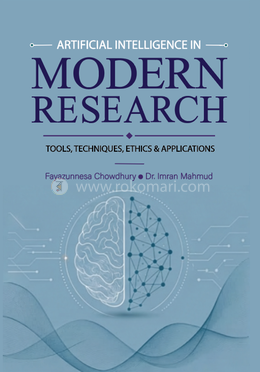
Technology has never been done without research. Democracy in knowledge was made through the printing press. Quantitative inquiry was speeded up through statistical software. Geographical restrictions to academic access were eliminated by the internet. The next disruption, however, is Artificial Intelligence, which changes the way research is done, or the very way knowledge is discovered, organized, proved, and shared.
The book targets researchers, graduate students, early-career academics, and institutional leaders interested in learning about AI as infrastructural, rather than fashionable, change in the contemporary scholarship.
Artificial Intelligence is perceived as a danger to the intellectual integrity, or the wonder of the world. Both extremes distort reality. AI is not a substitute of human reasoning. It does not create any real novelty in isolation. It lacks the aspect of ethical responsibility. What it does is it makes cognitive workload smaller, procedural friction Automated and scales the level at which researchers can work.
The object of this book is then two-fold:
1. To offer a systematic, practical manual on how to implement AI into research processes in a responsible way.
2. To contextualize AI in terms of the wider academic, ethical and institutional context.
The discussion is developed based on foundations to tools, applications to governance and lastly the future research architectures. Examples are given across a variety of spheres, such as agriculture, healthcare, education, and emerging data ecosystems, with the specific attention to the conditions of developing research environments.
It is not the book on replacing the researchers with machines. It is a book concerning empowering researchers with smart systems- without giving up intellectual accountability
 Hotline: 16297 (9.00 AM to 11.00 PM)




 Hello, Sign in
 Cart
Cart 


.svg)